
If you need more than about 4,000 egg trays an hour, a double rotary machine is usually the better buy. Below that, a single rotary machine does the job for less money. The rest of this article explains where that line comes from.
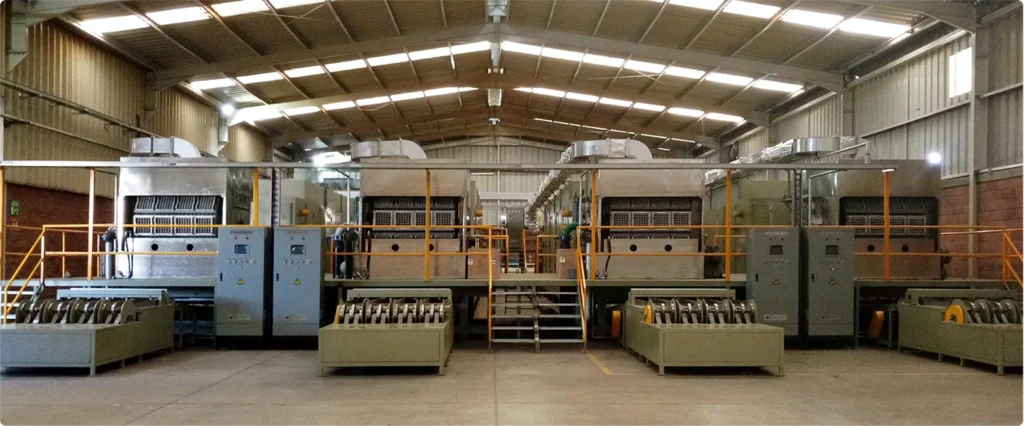
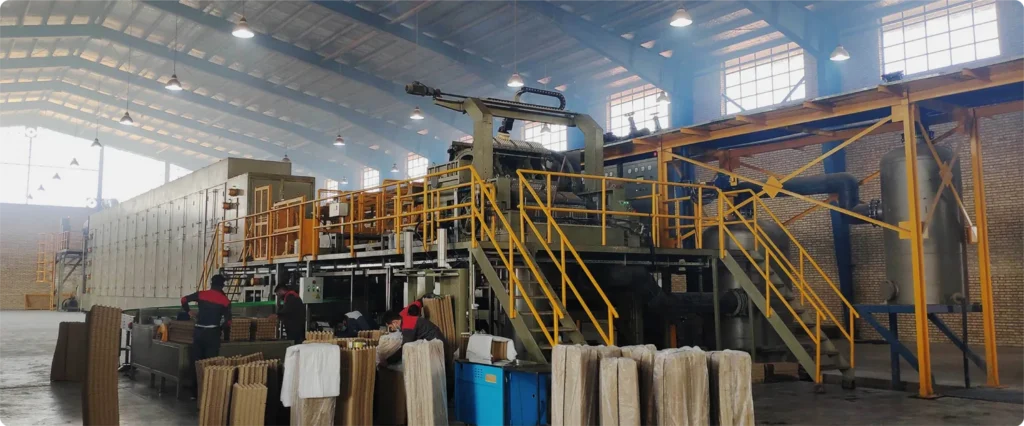
How the two machines differ
A rotary egg tray machine forms wet pulp trays on mold faces that turn through a slurry tank. Vacuum pulls fiber onto the mold, the mold swings up, and the wet tray is moved onto a conveyor that feeds the dryer.
In a single rotary machine, one rotating drum carries all the forming molds and also handles the transfer. Most come with 3, 4, 5 or 6 faces and turn out roughly 1,500 to 4,000 trays an hour.
A double rotary machine adds a second rotating assembly. Forming happens in one place while the wet trays are picked up and moved in another, so the two jobs overlap instead of taking turns. Typical output is 4,000 to 8,000 trays an hour, sometimes more. Suppliers build these machines differently, so ask exactly what “double” means in the model you are quoted. The figures here are typical ranges, not guarantees.
| Single rotary | Double rotary | |
|---|---|---|
| Output (30-cell trays per hour) | ~2,500–6,000 | ~8,000–12,000+ |
| Purchase price | Lower | Higher |
| Workshop space | Smaller | Larger |
| Maintenance | Simpler | More moving parts |
| Labor per 1,000 trays | Higher | Lower at full load |
Where a single rotary machine runs out of room
To get more trays from one drum, makers either add faces or turn it faster. Past four or five faces the drum gets heavy and harder to keep balanced. Turning it faster shortens the time the pulp has to dewater on the mold, and you see that in the product: thin corners, soft walls, more rejects. You can push a single rotary machine to the top of its range, but you pay for it in scrap and wear.
Why double rotary makes sense above about 6,000 trays an hour
Take a plant that needs 7,000 trays an hour. One way to get there is two single rotary machines, each with its own pulping tank, vacuum pump, operator and spare parts. The other is one double rotary machine. The second option generally takes less floor space and fewer people, and gives you one pulping and vacuum system to maintain instead of two. The machine itself costs more, but the cost per tray comes out lower once the line runs full shifts.
Quality improves too. When forming and transfer overlap, each step gets its full time, so the walls come out more even and the wet trays are handled less roughly. That matters if your customers are egg farms or supermarkets that send back deformed trays.
Growth is the other reason. If you make 4,000 trays an hour today and have orders that will push you past 6,000 within a year or two, a single rotary machine bought now usually means buying again soon.
When to stay with a single rotary machine
Below about 6,000 trays an hour, a single rotary machine is the sensible choice. So it is if your paper supply or customer base is not settled yet, or if your workshop and power supply cannot take a bigger line. A double rotary machine running at half load earns less than a smaller machine running flat out. Many first-time buyers do better starting with a single rotary machine and adding a second line later.
Check the dryer before you decide
The drying line usually sets your real output. A double rotary machine making 8,000 trays an hour needs a dryer sized for 8,000, and the pulper, vacuum system and hot press have to keep up as well.
Conclusion
Single rotary machines are the practical entry point: affordable, simple, and ideal for small to medium production. Double rotary machines are built for scale, offering higher output, better efficiency, and lower cost per tray once volumes pass roughly 4,000 trays per hour. Start by defining your realistic daily output, available space, and budget, then choose the machine that fits that target, not just the one with the lowest price tag.
Before buying, ask suppliers for exact capacity figures, power consumption, and references from customers running the same model, and if possible, visit a working plant to see the machine under real production conditions.
