
The best egg tray machine is the one whose rated output matches your daily tray demand and whose dryer can run on the fuel you have locally. Output is the first filter: HGHY’s rotary egg tray lines are rated from 2,000 to 6,000 pcs per hour, and its double rotary lines from 7,000 to 12,000 pcs per hour. All of them turn waste paper into molded pulp trays.
This guide explains how an egg tray machine works, how to size one against your own demand, what to compare between suppliers, and the specifications of six HGHY models as listed on HGHY’s own product pages (checked 8 October 2026).
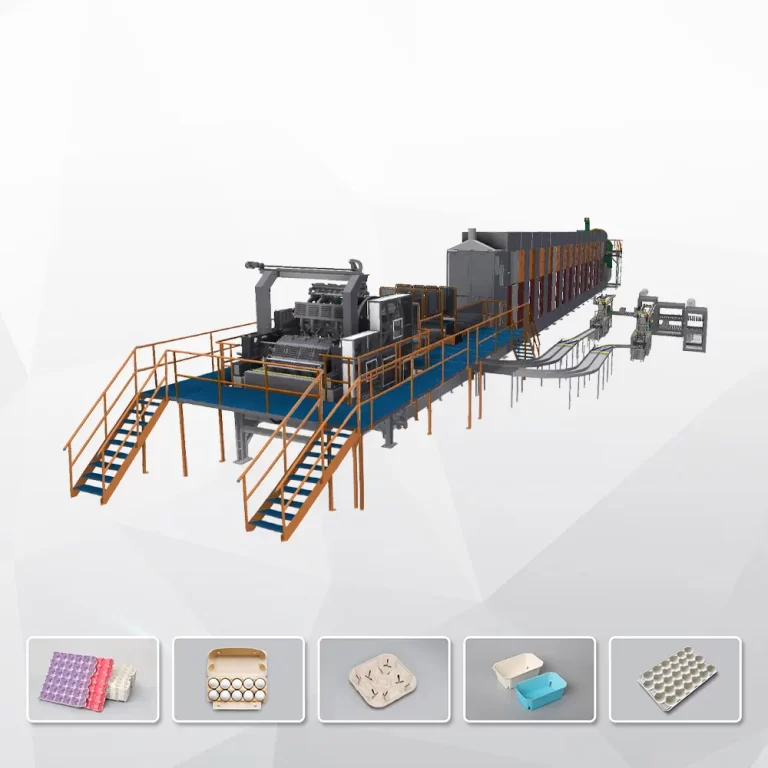
How does an egg tray machine work?
An egg tray machine, also called a pulp molding machine or egg carton machine, turns waste paper into molded trays in four stages: pulping, forming, drying and stacking. A pulper mixes waste paper with water into a slurry. Forming molds pull the slurry onto tray shapes under vacuum. A multi-layer dryer removes the water, using diesel, natural gas, LPG, LNG, or a steam or conduction-oil boiler. The dried trays are then counted, stacked and compressed for packing.
HGHY lists newspaper, used cardboard, paper-mill remnants and printing surplus as suitable waste paper. The same lines can also make fruit trays, cup-carrier trays and bottle trays, up to a maximum product height of 70 mm.

Rotary or double rotary: which type do you need?
The forming type sets the output ceiling. Rotary machines (HGHY’s B1C series) form trays on rotating platens and cover 2,000 to 6,000 pcs per hour with a 6-layer dryer. Double rotary machines (the B2C series) pair six forming faces with six transfer faces and a 10-layer dryer, and run at 50 to 60 drops per minute. HGHY describes that as about three times conventional speed.
Double rotary only makes sense if your demand justifies 7,000 pcs per hour or more. The line is longer (72 to 90 m against 50 to 72 m) and needs more labor per shift (5 to 7 people against 3 to 5).
HGHY egg tray machine models compared
| Model | Forming | Platen (mm) | Output (pcs/h) | Output (pcs/day, 24 h) | Dryer | Floor plan (m) | Labor per shift |
| 2000B1C | Rotary | 1600 × 400 | 2,000 | 48,000 | 6 layers | 50 × 18 × 6 | 3–4 |
| 4000B1C | Rotary | 1600 × 560 | 4,000 | 96,000 | 6 layers | 60 × 18 × 6 | 4–5 |
| 6000B1C | Rotary | 1950 × 420 | 6,000 | 144,000 | 6 layers | 72 × 18 × 6 | 4–5 |
| 7000B2C | Double rotary | 850 × 460 | 7,000 | 168,000 | 10 layers | 72 × 18 × 8 | 5–6 |
| 9000B2C | Double rotary | 1250 × 460 | 9,000 | 216,000 | 10 layers | 90 × 18 × 8 | 5–6 |
| 12000B2C | Double rotary | 1650 × 460 | 12,000 | 288,000 | 10 layers | 90 × 24 × 8 | 6–7 |
All models use waste paper as raw material. Output is rated in pcs as listed by HGHY, so confirm the tray size and cell count the rating is based on before you compare it with another supplier’s figures.
How to size an egg tray machine to your demand
Start from trays per day, not from the machine. Divide the eggs you need to pack each day by the cells per tray (a standard tray holds 30). As an illustration with assumed numbers: a farm with 100,000 laying hens at about 90% lay produces roughly 90,000 eggs a day, which is 3,000 thirty-cell trays a day.
A 2000B1C is rated at 2,000 pcs per hour, so a single 8-hour shift gives about 16,000 pcs. That is enough for roughly five farms of that size, before you allow for peak season and downtime. If you sell to many farms and distributors, work out the total the same way and move up the table.
What else to compare between egg tray machine suppliers
- Rated output and its basis: tray size, cells per tray and operating hours per day.
- Dryer fuel and consumption: ask for fuel use per 1,000 trays on your fuel type. Drying is typically the largest running cost in a pulp molding plant.
- Floor space and building height: see the floor plan column above.
- Labor per shift: this changes your running cost more than the machine price does at higher volumes.
- Delivery and installation: HGHY lists about 130 days from order, deposit or L/C to shipment, and 60 to 90 days of installation depending on the equipment. HGHY sends two guide installers and the customer arranges the installation crew.
- Reference plants: ask for operating plants in your country that you can contact. HGHY says it has helped more than 300 clients in over 60 countries, which is a company figure you should verify with references.
- Spare parts and after-sales support.
How long does an egg tray machine take to pay back?
HGHY states that its egg tray lines usually pay back in 2 to 3 years. That is a supplier estimate. Your own result depends on the price of waste paper, the selling price of trays, fuel cost and how fully the line is used, so ask for a worked example using your local numbers.
Frequently asked questions
Which is the best egg tray machine?
There is no single best model for every buyer. Match rated output to your daily tray demand, pick a dryer that suits your fuel, and check floor space and labor. For 2,000 to 6,000 pcs per hour, look at HGHY’s rotary B1C series. For 7,000 to 12,000 pcs per hour, look at the double rotary B2C series.
What raw material does an egg tray machine use?
Waste paper: used newspaper, cardboard, paper-mill remnants and printing surplus.
What is the capacity of an egg tray machine?
HGHY’s six models range from 2,000 to 12,000 pcs per hour, or 48,000 to 288,000 pcs per day at 24 hours of operation.
What fuel does the dryer use?
Diesel, natural gas, LPG or LNG, or a steam or conduction-oil boiler, according to HGHY.
How much does an egg tray machine cost?
Price depends on the model, the dryer system, the auxiliary equipment and the destination. HGHY does not list prices on its product pages and quotes on inquiry.
How long does delivery take?
About 130 days from receipt of the order and the deposit or L/C, per HGHY.
